Pages

Showing posts with label kiev. Show all posts

Tuesday, January 24, 2012

Orange County Event Architects: A Q&A with Ashley Eckenweiler and Luke Allen of OC Music Awards


How did you end up in Orange County?  How did you two end up meeting and starting your work together?

Luke Allen: I moved here from Vermont, 8 years old, to Oceanside, then to Orange County at the age of 10.  Just played in local bands, went to Woodbridge High School, and lived in Irvine.  Then I started a music rehearsal studio, Gemini Studios, right out of high school.  I’ve been doing that since July of 2001.  That’s kind of how I got involved in music, and eventually the OC Music Awards.  Gemini Studios was a sponsor in 2008, and the Producer at the time was taking off and moving to Spain. He asked if I wanted to do this awards show that we have, and I told him, ‘You know what, I think I do,’ just because of years of meeting bands and helping them with rehearsal space.  The eternal question of the bands was always, ‘What do we do next with our music careers in Orange County?’  I didn’t have any answers other than just play shows.

A lot of the time, the answer seems to be, go to Los Angeles.

Allen: I would certainly say the same thing as everyone else, you know, go play LA.  Silverlake or Sunset, it’s part of the way of getting more exposure.

So when and how did you and Ashley get connected?  When did you decide that you wanted to work together?

Allen: Ashley has an extensive music career in Orange County that goes back a long ways.

Ashley Eckenweiler: I was working in LA, I had my own business up there for four years for PR, mostly for art institutions and galleries.  I got hired as the Director of Special Events at Orange County Museum of Art in 2005.  I started a music series called Orange Crush.  It was the first cultural institution to bring Indie 103.1 down as a radio partner.  So we did a monthly concert series.  We had Silversun Pickups, Matt Costa, The 88, Ozma, Sonic Youth—we had a really great lineup for about two years and they were all free shows.  Then I left the museum and started my own business in 2008.  I met Luke that year at OC Metro’s 40 Under 40, which he and I were both a part of.

Are you from Orange County originally?  Did you grow up going to shows in the area?

Eckenweiler: I grew up here until I was 16, then moved to New York.  I was a dancer with New York City Ballet.  So I joined the company really young, and I finished high school in New York.  I stayed there until I was 20, decided I wanted to do other things, tried to stay, was broke, and left.  So I went home and then moved to LA about a month later.  I can honestly say that I never went to a show in Orange County growing up.  The Orange County Performing Arts Center was one of the first stages I danced on professionally when I was eight years old, and now they are a client, so it comes full circle.  And then Luke and I met, and he asked me to lunch.  At that time he had the Awards, and for the first year he produced, and I came on as mostly PR and Talent.

Allen: I just had experience in the rehearsal space. I hadn’t booked shows—just played in shows in a pop-punk band back in the day.  I had had some experience with bigger bands that we were friends with that practiced at my studio, and ones I was a fan of.  I wanted to be able to help with the platform that could actually advance bands that are looking for more, and are actually motivated to do it themselves—what can I do next, what’s the next step, and how can I do it here?  I wanted to help fill an answer for that question.  I thought the Awards could do that, and when I took it over, I knew that I needed help.  Ashley was the best person, probably in all of Southern California, and I just happened to luck out and meet her.

Eckenweiler: Well and he was very special too.  I mean, a typical county awards show model isn’t necessary successful and doesn’t activate the community or give something back to the artist.  He had the right mission and vision and direction for the event.

Everywhere I go, people have this inclination to tear Orange County down when it comes to the music scene.  But it’s all about the way that we treat it.  If it’s going to be negative, of course it will be viewed negatively.  But once you start supporting, all of a sudden, everything changes.

Allen:  Yes, it is manifest destiny against the headwind of preconceived notions about all of Orange County; not just in music and art, but everything.  The county usually gets the ‘ridiculous’ wrap, not to be taken seriously.  And sure, maybe there is an aspect of it that isn’t as deep as other cultural epicenters of the world, but, you can find whatever you’re looking for in Orange County--talented artists, painters, musicians, and writers can be found everywhere you look.  There is the perception to overcome, but you could also not really worry about it and just do what you think makes sense, and try to help the people who are excited and want to do it themselves.
 
Ashley, you have now officially bought the OC Music Awards.  What made you and Luke want to take it on in the first place?

Eckenweiler:  Well, Luke purchased it from Martin Brown while Gemini Studios was a sponsor.  I think Martin was looking to sell it, and Luke saw the potential.  I’d never been, so I didn’t even know what it was.  Luke decided to buy it from Martin before I even knew him, so that was his decision.  Then we met, I think it was pretty shortly after he bought it and he was looking to kind of refresh the format of the event, so that’s why I got involved.  He was really passionate about giving musicians opportunities in their own town—so expanding what’s going on in Orange County, and kind of highlighting the local talent.

How would you say the Awards have progressed since 2008?

Eckenweiler:  I had been working in local music for a long time, and I remember a lot of the bands had never heard of it, or they had mixed reviews about it because there were some pay-to-play options—like pay to submit and be a part of, and pay to attend.  There were more barriers of entry basically, so I think the reputation of the event has definitely developed to become known as an event that is looking out for the best interest of local bands, and really looking to help them grow and succeed in their hometown and beyond.  As far as from a branding perspective, we’ve reached a much larger audience than it used to.

Just within the Best Live Band and Best Acoustic events, the audience has grown considerably.  Which of the bands are you most excited about right now?

Allen: Young the Giant.  So proud of those guys.  I saw them perform at the Irvine Heritage Cultural Center in their teens as The Jakes.  They were practicing at the studio, and now they have done a worldwide tour, opening up Weenie Roast, having a great time in life, as far as I know.  So it’s really cool to see that.  Obviously, our OC Music Awards artists have gone through the showcase series, been nominated, participated in many ways.  I think that’s a really wonderful thing to see them excited about that.  Hopefully it’s giving them a chance to network with other bands, create shows, and feel some sort of energy and community through that.  It’s great.

Eckenweiler: It’s tough to say.  I look at local music as kinda having an umbrella, so that certain favoritisms don’t develop, but I was really excited to see a lot of new names in our showcase series this year.  A lot of those bands that are just starting I’m excited to see what they do next.  I’m obviously really proud of the bands that have made the jump this year—Young the Giant, Kiev getting a Rolling Stone interview—there’s a lot of progression that has happened for a few of the artists that have been involved, so that’s really fun.  One of my OC Music Awards interns was asked in an interview, ‘What’s your favorite local band?’  She said, ‘The Jakes! I mean, Young the Giant!’  It was so cute.

That shows how far back she has been listening to Young the Giant.

Eckenweiler: I know, dedication!  I think it’s great to see that progression.

Ashley I want to ask you more about—I’d call it your side project, but it’s more your main job—the ACE Agency?

Eckeweiler: ACE is not a side-project, it’s what we do everyday, and it’s what allowed us to take over OC Music Awards.  I started ACE in 2007, but I started my own business 10 years ago in PR in LA and it was mostly for art and live music.  I represented a few galleries and worked in different live music spaces like—back then—Cinespace and Vanguard, Beauty Bar and Star Shoes, which doesn’t exist anymore.  I did a lot of PR and live music/art events.  This was back in about 2001 or 2002.  That led me to taking a position at the Orange County Museum of Art in 2004, and I was their Director of Special Events.  That was my first Orange County job, if you will.  We implemented live music programs, which were very successful and kind of paved the way for that time when museums started really looking at music as a way to bring in new audiences.  We were the first to partner with Indie 103.1 and bring the station down to Orange County.  That was the time on the radio when they were calling out that they were from LA and Newport Beach.  It made no sense because they never came down to Orange County, why would they call out Newport Beach?  But we were in Newport Beach, so I saw the tie there, so we brought the station down to do shows with Silversun Pickups, Sonic Youth, Pavement, Matt Costa—we had great, amazing bands.
 
This was all at the Orange County Museum of Art?

Eckenweiler: Yeah, and they were all free, so it was a really exciting time.  Those programs were around 2006, so I was at the museum for two years, and then I decided to go back on my own, and I continued to work with the museum as a partner for a while and did some more music.  Then Segerstrom Center for the Arts became my second client, and that’s when we started what we called the Off Center Festival.  It was the first time that the center was welcoming in alternative music.  We had Peter, Bjorn, & John, The Walkmen, Coldwar Kids, Jose¢ Gonzales, Rogue Wave, and Camp Friday.  So that kind of paved the way for ACE.  Our initial mission was to implement PR and Marketing through alternative event environments, and experiential marketing—how to find your new audience, and how to create an experience that will cultivate them and bring them to you—that’s kind of our philosophy. That was in 2007-2008.  We’ve continued to do that, but our business plan has really expanded, so we handle PR, social marketing, media, special events, and brand partnership.  We have about 12 permanent clients right now, and then others come to us for one-time services and one-off support.  It’s not just music and art focused, because PR is PR, and once you understand one avenue, you can figure out another.

So I would say OC Music Awards is more of your side-project.

Eckenweiler: We look at it as a client.  We treat OC Music Awards just as we would treat Segerstrom or Burke Williams, or anyone that we’re working with.  We have to manage it day-to-day and treat it like a business, otherwise, they’re going to fire us.

Fire yourself?  I’d say you’re doing a great job and won’t need to worry about that.  Tell me more about the prizes that are being offered this year, not to just bands, but to the fans as well?

Eckenweiler: We haven’t announced what the showcase series prize-packs are going to be yet.  The first year in 2008, we didn’t offer any prize—it was just the title and the opportunity to perform at The Grove of Anaheim.  We wanted to make the participation more about the notoriety—just being involved in the experience, and let the prizes be announced later.  So we haven’t announced those yet, but we will at the beginning of February.  We have more partnerships this year than ever before.  Farmer John is a very exciting addition to the event, and a presenting-partnership is a big deal to the Awards, and it’s very helpful to keep the event going.  We’re looking for ways to activate our partners onsite, and help to connect with the audience and the musicians.  That’s where the guitar giveaway came from.  Farmer John, KROQ, and Ernie Ball wanted something that the fans could take home that would remind them of OC Music Awards and their involvement, so Ernie Ball and Sterling by Music Man are donating one guitar per showcase series, and KROQ designed a custom pick-guard.  We’ve also got the Farmer John Fan Vote, so fans log on to vote for their favorite showcase series artist, which moves one artist on to the finals, and by voting, you’re entered to win a guitar per showcase.


Someone will win that guitar at each individual showcase then?

Eckenweiler: Yeah, and we announce the winner on Facebook the next day.

What details do you have about the participating venues?

Eckenweiler: It has become traditional to kick-off the Best Live Band Showcase at Detroit Bar.  I don’t know if we’ll ever change that as the kick-off to the event.  The District is also a partner, so we always kick-off the Acoustic Showcase there, so again, those are our two, kind of, reoccurring, consistent spots.  Malone’s—we always like to add somewhere new, maybe a venue that you don’t frequent or think about necessarily.  We kind of did that with Tiki Bar last year.  We hadn’t been there before.  At Malone’s, Mike Concepcion (of Gypsy Lounge) is doing the sound there.  We wanted to keep our Gypsy Lounge tribute, and work with Mike again, so that’s why we’re going to Malone’s.  Slidebar has become a great venue partner, so there was no question about going back there again.  Continental Room—we didn’t go last year, but the year before, so we thought we’d revisit.  To make it different, we’re doing an Acoustic Showcase there ‘cause we thought it might be fitting for the stage size.  And then Constellation Room is one of our newest venues, so I’m excited to go there for the last showcase.  And then the Finals—we’re going to Coach House on Wednesday 22nd (February) for the Acoustic Finals, and then Friday 24th will be at Segerstrom for the Best Live Band.  We’re going back to the Samueli Theater, so that will be fun.

It was amazing watching Kiev’s 3D show that you put on at the Samueli Theater, plus you already have a great relationship with the Segerstrom Center for the Arts, and that theater is huge…

Eckenweiler: Yeah, we’re excited about that, and we’ve never been to Coach House and that’s a staple venue in Orange County.


That should help get South Orange County involved a little more.

Eckenweiler: Yeah, we went to OC Tavern one year and that’s a far South as we had been.  I was in traffic thinking, ‘Where are we going?’ I forget how big Orange County is.

Past San Juan Capistrano, it seems like a different county almost.  How do you feel about the bands that have expanded out of Orange County?

Eckenweiler: I think it’s great.  A lot of people don’t want bands to leave, but I don’t really have an opinion on that.  I think that everyone should be proud of where they came from and call out Orange County if they’re from here.  If they need to move or they want to move, that’s fine.  I think OC Music Awards definitely helps bands reach new audiences and hopefully connects them with some industry professionals that will help their careers.  Some may still need to move.  I think it’s pretty typical for people to want to move from where they came from—whether it’s that they came from LA, and they want to move out of LA, or if they came from Orange County, they might want to move out of Orange County.  Obviously LA is a bigger place, and there’s more going on, but there’s enough down here to keep things going.  You see that with some of the larger bands that still have homes here, still work here, still record here.  All the things that you can do here, they do, so it’s totally possible.

Allen: The cool thing about a place like Detroit Bar in a place like Orange County is that, you can play LA and be a small fish in a huge pond where you could swim forever to get bigger.  But, you come down and play a venue like Detroit, and you have an instant new audience immediately.  You’re playing a concentrated area in a geographically huge county.  If you do a residency at Detroit Bar, you just got Orange County.  And it can take you years to get LA, if you’re good and you promote correctly. 

There’s more to be proud about these days in Orange County.

Eckenweiler: There is.  I don’t think Young the Giant will ever cover up where they’re from, so that’s good.  And look how successful they became, I mean, how great is that?


It shows every other band that it’s possible, as long as you’re going for it and stick to the plan, keep making contacts, and work hard.

Eckenweiler: That’s really important, it was nice to see that happen for two different Southern California bands this year, Foster the People and Young the Giant, and almost Grouplove—they’re right there.  From all the music all over the world, that happens to these two Southern California bands—it’s cool.

What do you see in the future for the OC Music Awards?  Are you always thinking of adjustments and new additions?

Eckenweiler: Yeah, we definitely see room for expansion and improvement.  We continuously look to involve more of the local community, whether it’s through artists, or partnerships, or businesses—we’re constantly working to expand those relationships and continue to give more opportunities and connections to the artists.  We’re looking at how to expand the Awards, whether it’s through venues, or more dates, or being able to involve more people in some of the shows is a key goal for the future.  We kinda kept the categories the same as last year, but we’ll always look at how those reflect on the music that’s being developed, and you know if we need to add more genre categories…

Maybe Production categories?

Eckenweiler: Yeah, that’s been a big one that keeps coming in through our radar.  This year we were really about growing our partnerships, and continuing to make sure that the Awards are a stable and respected platform, and continue to provide things for musicians.  We didn’t want to expand too much, ‘cause we had a lot going on with the transfer.

I can’t imagine sitting down to organize every last detail.  There’s so much that goes into creating one event, let alone 10 events.

Eckenweiler: Yeah, there’s a lot of moving parts, and it’s important to us that we keep all of our partners happy, all the bands happy, all the venues—there’s a lot of people involved, so this year is really about sustainability and making sure that this is a viable event that continues to provide opportunities to the community, and then we’ll look at how to expand it next year.  There are tons of possibilities.  We’ve brainstormed about licensing opportunities, or how we can sustain the brand, the presence that it has throughout the year.  We have the season and we need to focus on that, but how do we get the name out, who do we partner with in the Summer and the Fall.  Potentially SXSW presence in 2013, I could go on and on and on.  Every year we hope to add to it and build it, and I think the presenting-partnership with Farmer John is our biggest add-on this year.  Our partners help sustain the event and make sure that it actually happens, so without them we couldn’t do it.

I’m sure the artists appreciate all that hard work.

Eckenweiler: It’s great to see them come back.  It’s so interesting to see who comes to each show, and the familiar faces throughout, who kinda has gotten busy, and those who wish us their best via email (laughs).

Wednesday, January 4, 2012

OC Music Awards 2012 Nominees Announced


OC MUSIC AWARDS ANNOUNCES THE 2012 NOMINEES IN 21 CATEGORIES


(ORANGE COUNTY, CA) – The Awards Academy has voted, the ballots have been sorted and the 2012 OC Music Awards nominees in 21 Academy selected categories have been determined. The 2012 list of nominations welcomes back some OC Music Awards former winners and nominees as well as some fresh faces.

This announcement includes 21 of the 26 total 2012 Awards category nominees. Still to come are the Outstanding Achievement Awards for OC Impact and Lifetime Achievement to be announced the February 1, the Best Live Band and Best Live Acoustic Showcase Series finalists, which will be announced after the last Showcase on February 15, and The People’s Choice Award nominees, to be announced on Monday, February 27. Make sure to cast your
 FARMER JOHN FAN VOTE for your favorite Showcase artist to help them advance to their category Finals, and vote online for your favorite band in Orange County to receive the People's Choice Award.

And the 2012 nominees are….


2012 OC Music Awards Nominees(Nominees listed in alphabetical order per category)
Best Album
The Aquabats - Hi-Five Soup!
Jeramiah Red - Ghost Tracks from the Getty
Social Distortion - Hard Times And Nursery Rhymes
Thrice - Major/Minor
Young The Giant - Young The Giant


Best Song
DJ Tempo - "June Serenadez" featuring Ashley Morphew
Jeramiah Red - "Can't Help Myself"
Kiev - "Loot Recovered"
Thrice - "Promises"
Young The Giant - "Cough Syrup"


Best New Artist
Ethan Hulse
Golden Afternoon
Jeramiah Red
Portrait of a Nightmare
The Ultimate Bearhug


Best Alternative
Ceasefire
Jack's Mannequin
Railroad to Alaska
Suedehead
Young The Giant


Best Blues
Jameson
Jeramiah Red
Parker Macy Blues
Robert Jon & the Wreck
Roman Alexander & The Robbery


Best DJ
DJ Bobby Soul
DJ Oldboy
DJ Tempo
DJ Thrifty Lips
Kedd Cook


Best Country/Americana
Big Sandy & the Fly-Rite Boys
Billy Kernkamp
Falling Stars
Jeramiah Red
Nicole Vaughn


Best Electronic
Blok
Electric Valentine
Free the Robots
Mphase
Speaker Junkies


Best Folk
Ethan Hulse
Field Trip
I Hate You Just Kidding
Micah Brown
The Ultimate Bearhug


Best Hip Hop
BLOK
Cirious and Deelux
I&I
Pwest
Speach Impediments


Best Indie
Kiev
The Devious Means
The Gromble
The Steelwells
Young the Giant


Best Jazz
Chris Williams
Evan Stone
Nancy Sanchez
Ron Kobayashi
Tony Guerrero


Best Latin
!Aparato!
Boogaloo Assassins
Nancy Sanchez
Signa
The Latin Jazz Syndicate


Best Metal
Anna Vexa
Avenged Sevenfold
Bleeding Through
Death By Stereo
Railroad to Alaska


Best Pop
Amanda Lamb
The Aquabats
Ethan Hulse
Stacy Clark
Suedehead


Best Punk
Audacity
Chaser
Death Hymn Number 9
The Adolescents
The Gospels


Best Rock
Echo Echo
Jeramiah Red
Red9
Thrice
Young The Giant


Best Surf
Alejandor Awesome Surf Band
Death Hymn Number 9
Headshine
Hindu Pirates
The Growlers


Best World
80 Proof
Craic Haus
Dirty Heads
Reel Big Fish
Seedless


Best Music Video
Blok - Jungle Dog Fang Hell
Red9 - Fanatico
Red Devil Squadron - Bobcat Wrangler
Semi Sweet - Chemicals Corrected
Young The Giant - Cough Syrup


Best Youth
CHIXX RULE
McKenzie Brandon
Ugly Paint
Un D Vided
Whiplash
Visit OC Music Awards online, become a FanFollower, and Subscriber

Sunday, October 9, 2011

Night of Sweet Relief with Bill Bennett

          Recently, I sat down with the President of Sweet Relief, Bill Bennett, to discuss his role in the non-profit organization created to aid musicians facing major health issues, as well as his personal upbringing in the music industry.  After spending over three years revamping Sweet Relief with his partner, Rob Max, Bennett has expanded the success of the non-profit in a huge way since the initial conception by Victoria Williams in 1994.  Nothing shows this better than the Night of Sweet Relief this upcoming Saturday, October 15th, in which hundreds of venues from all of the country are pitching in to raise funds for artists in need.  Locally, House of Blues Anaheim will host its own Sweet Relief event featuring Kiev, Jeremiah Red, May McDonough & Co., Paulie Pesh, and I Hate You Just Kidding.

How long have you been in the music scene?

I’ve personally been in and around music forever.  My first jobs were in record stores.  I was always the kid with the most albums of all my friends.  I’ve always been infatuated with music, and I always wished I was a musician, but never had quite the talent to pull it off—at least in any real satisfying way.  Although, these days I could probably pull it off because not as much is required.

It’s true, you can get away with a lot with the electronics that are available.

Well, yeah.  When I was 20 years old, the concept of being a professional musician was very different from today.  The labels controlled the industry, and there were five or six of them.  If you didn’t get on a major label, you didn’t exist.  So the number of people who actually made a living as musicians was very small.  It was very much a filtered process that you kind of depended on the labels to decide for everybody what was considered good.  If the labels didn’t think that you were good, then you just fell through the cracks for the most part.  You didn’t have a ton of indie labels out there putting stuff out.  Obviously things have changed extraordinarily over the past few years.

Musicians are producing their own stuff without labels.

There’s no need for anyone else.  That’s good and bad.  If you’re a music fan, it’s a double-edged sword because it’s great that there is all this music to listen to…but, there’s all this music to listen to, and no one telling me which ones are the good ones.  That’s why blogs have become so important, because they are similar to the record labels because they dictate what is considered good.  If something is hitting it hard on the blogs, then that’s what people will listen to.  So getting back to your original question… From my teenage years, I was always doing something music related.  I managed my first band when I was 21, which was a Grateful Dead cover band in New Jersey.

Is that where you’re from?

Yes, I’m originally from New Jersey.

When did you come out to California?

I came out here when I was 23, which was 1991, and ended up working for Wherehouse Entertainment where I was a general manager.  I was doing that for a couple of years, and then I left Southern California to go to Boulder, Colorado.  I went there with the intention of working in a venue.  I wanted to run a venue, or I wanted to own a venue or something to that nature.  I knew I wanted to be around live music, ‘cause I was very much over retail at that point and wanted nothing more to do with that.  I remember I showed up there with no place to live, no job, and I had brought a buddy with me.  I always got wingmen to jump off the cliff with me for some reason.  We saw this place called the Fox Theatre, which was right across from the University of Colorado, in a section called The Hill.  It’s an old movie theater similar to The Yost—it has that kind of a vibe to it with the old-style marquee.  On the marquee when I got there was Sheryl Crow.  This was right when Tuesday Night Music Club had only recently come out, and so she was still relatively new.  The Fox Theatre held around 700 people, so it’s a modest venue.  I looked at that, and thought, this looks pretty cool.  I walked in and it had a café—almost like diner-style food is what they served in the lobby there and it was open during the day.  You could walk into the venue and it was totally dark, but you could still see what the layout was and I just kept looking around.  I said to my friend, ‘Yep, this is it.  This is where I’m gonna be.  This is gonna be my home for awhile.’  He looked at me like I was crazy, like what did I see in this place, there’s nothing here.  I went upstairs and asked about a job.  I was very presumptuous.  I asked, ‘Do you have any management positions available?  I’d like to be a manager here.’  The girl looked at me like I was crazy, like ‘What do you mean manager?  Who are you, first of all, and we’ve been open for three years and everybody who is a manager here, including myself, has been here since the day it opened and none of us are planning on going anywhere, so you should probably put that thought out of your head.’  So I said, ‘Oh, alright…well what do you have that’s available?’  She asked me what could I do, and I told her I could do a little bit of anything, and I’ve done some sound work before.  She goes, ‘Ok, this is the person you need to talk to for that.  You look like a big guy, have you considered being a bouncer or a doorman?’  I told her, ‘I’d rather not, but whatever it takes.’  I ended up talking to the sound guy, and he was like, ‘We can certainly bring you on, but you would probably have to work for free for a while and just kind of intern, and then we would work you into the schedule if you were good and stuck it out.  You should really talk to the head security guy ‘cause I think he’s looking for people.’  I ended up talking to security, and sure enough he did.  When he took one look at me, he said I was hired.  Even though that was the last thing that I really wanted, ‘cause I hate that kind of vibe—I don’t like being the enforcer and I’m not a violent person, despite my size.  But I took it and started working two days later.  Within three months, they had created a new management position for me, and within a year and a half, I was a general manager of the Fox Theatre.

Stuck to your guns, eh?

Once I saw it, I knew it was the right thing.  I just took the approach that this was where I needed to be.  I would literally go in there and, even though as a bouncer I only needed to be there from 9pm to 2am on any given night, I would show up there at 9am to10am in the morning and just answer the phones and do whatever.  I’d just hang out, help out, and kind of act like an intern basically—do whatever work they needed.  It showed them that I was serious about it and that I was willing to learn and do whatever it took.  The job we ended up creating was a box-office, one that didn’t exist.  Prior to that, they were just selling tickets through the restaurant and it was kind of sloppy.  We opened up a box-office across the street that was going to sell tickets for the Fox as well as other venues in Denver and Boulder.

When did you end up leaving Colorado?

I left Colorado in ’01, literally the week of 9/11; which of course was not planned, it just happened that way.  I remember driving from Colorado to LA stopping in Vegas, and this was 9/16 or so and it was empty.  Vegas was empty.  There was nobody there.

Nobody was traveling?

No one was that first week or two.  I think airplanes had just started flying again, but people were not anxious to go anywhere because they were still in shock.  Thinking of going to Vegas and having fun?  No.  It was surreal.  The roads were empty even.  People were at home, in shock, thinking, ‘What the fuck just happened?’

Meanwhile your whole life is changing?

I came out to California specifically for a job, and this was not in the music industry.  I was leaving the music industry to ‘grow up,’ and I was going to work in the Hospitality industry.  I had been offered an executive position that paid well, offered benefits, and had upward mobility.  Seemed like the right thing to do at the time.  I was 33, and I’d had a good run in the music world.  It felt like it was time to settle down, so to speak.  Worst decision I ever made.  If I could change anything about my life, it would be the day I decided to do that.  I spent seven years in the Hospitality industry and was miserable for every second of it.  I thought it was the right thing to do.

It was the expectation?

Yeah, it was the expectation in my own head.  I should be able to buy a home, and I should be able to have a family, and blah blah blah.  You know, whatever that was.  I was looking at all my friends, basically, and they were all doing well.  They all had houses and nice cars.  Not that I care about that.  There was a lot of possibility with this company.  The potential for it to blow up into something big for me was pretty huge.  I was hoping that I would like it, and I guess I just didn’t.  It wasn’t music.

For seven years you were out of the music industry?

I stuck with it for seven years.  I stayed with it for as long as I did, partly out of loyalty to the person who brought me on ‘cause it was someone I was close with and they needed help.  Part of it was that it was solid and I was making good money.  I threw in the towel, I guess you could say, of ‘living the dream.’  I’ve always been a dreamer, but I thought that it was time to let that go, being the age that I was at.  But after seven years of misery, I decided that I was wrong; that I had made a big mistake.  I started thinking about how I could rectify that and change it.  I think I had met The Living Suns at that point and had gone to see them play.  Basically, the 2000’s had been a non-musical decade for me—at least the early part of it.  I’d go to shows here and there, but very little.  I really left it.  Meeting those guys—I met them at a Starbucks right across from where I live.  It was a changer for me, because I saw in them what I used to be, and how I used to feel about things.  We got to know each other, and it’s kind of random that we would have even decided to talk to each other.  They were a bunch of scraggly long-hairs, and I was a relatively mature business guy.  Typically when they saw me, I was dressed nice and going to or from work.  I’d seen them enough times where I felt compelled to ask them who they were.  There was always a group of them, ‘cause they all hung out there, and they just had this look about them.  I think I’d overheard some conversations about music and it peaked my interest to say, ‘Who are you guys?’  They explained who they were and we started talking.  I would tell them about my past history and eventually they started saying, ‘You should manage us.’  I’d tell them, ‘I’m making good money now…and your not making any money…why would I do that…?’  But it kind of stuck in me a little bit, ‘cause there was a part of me that really enjoyed having those conversations with them and being involved in creating their world, so to speak.  I reconnected with a musician friend of mine from Colorado who now lived in Los Angeles.  This girl’s name was Nina Storey, who’s a singer songwriter, and she asked me to come see her play in Santa Monica.  I did and it was the first time I had seen her in a couple of years.  She had done well, and as an independent artist, she had sold about 50,000 records, had a tour-bus at one point—all on her own, never with a label.  Great, incredible talent, and just a sweet girl too.  Although it was relatively smaller place she was at, her performance was amazing as always, and it was just her and her bass player doing a duo thing.  We ended up sitting down and talking afterwards, and we ended up talking for like three hours.  She told me about what she had been up to, and how frustrated she was because she couldn’t crack through and how things had gotten really hard for her career.  I told her where I was at and how I was miserable, and at the end of the conversation she asked, ‘Would you ever consider managing me?’  She’s someone who I had always thought very highly of, she was a touring musician, and made money.  That’s when I started seriously considering making the switch.  I thought about it, and I went for it.  I quit my job, and changed everything about my life to make it simple and inexpensive, ‘cause I knew it was going to be rough.  I had some money saved up, but had no idea what the future was going to bring, and I went for it.  So I started managing both her and The Living Suns.  I didn’t really know what I was doing.  I’d been out of the industry, so it wasn’t like I knew anybody, but I was supposed to be ‘Mr. Connection Guy,’ for both of them.  Except that a lot of the music people I had worked with had stayed in the music industry and were now big.  Same time that this was happening, Facebook was really catching on, so it was perfect timing for me.  I got onto Facebook and I started connecting with everyone I could.  A lot of them were people I used to work with in Boulder in the music industry.  The guy who used to book the bands at the Fox was now the Vice President with AEG.  He was booking all the shows at Red Rocks, the Pepsi Center arena there, so he had gotten much bigger.  The guy who was his assistant was now working for Live Nation in Denver and was a Vice President for them, and he was managing a band called Sound Tribe Sector 9 that was blowing up and doing well in the live electronica world.  People had gone on to pretty cool things.  The guy who took my place was the general manager of a place called Fiddler’s Green, which is a 20,000 seat amphitheatre in Denver.  That’s what everybody had kind of moved on to for those who had stuck with it.  So those were all the things that I felt I should have been doing, but regardless, it was cool reconnecting. 
How did you officially get connected with Sweet Relief?

One of the people I reconnected with was this photographer who had been in Boulder at the time and had taken a lot of pictures at the Fox.  When she lived here, she lived in Long Beach.  We went and hung out at some show like Que Sera or some place like that, and ended up talking and catching up.  She says to me after we’ve been talking for a while, ‘Do you remember introducing me to Victoria Williams?’  I go, ‘Of course.’  Victoria Williams is a singer/songwriter, who’s the founder of Sweet Relief.  She goes, ‘Well, we’ve become good friends.  We’ve been hanging out ever since.’  I go, ‘Wow, that’s really cool, that’s awesome.  How’s she doing?’  I knew she had MS.  She goes, ‘She doing ok physically.  But she’s having a problem with Sweet Relief.’  I go, ‘What’s going on?’  She tells me, ‘The person who’s running it has run her course, she’s been there way too long, she’s lost interest, and apparently they may close it ‘cause she’s just not into doing it anymore.  Victoria has asked her friends to be on the lookout for somebody who might be willing to take it over.  I think you would be perfect for that.  Would you consider that?’  I had a huge respect for Sweet Relief, and I was familiar with it from the day it started.

This was in 1994, correct?

Mmhm (nods).  So this is ’08 when this conversation is happening.  My mouth dropped, like, really?!  I couldn’t even fathom that because I always had Sweet Relief on this big pedestal as a well-known, successful charity.  She goes, ‘Yeah, do you mind if I connect you with her?’  I go, ‘Yeah, please.’  I think I met with Victoria very shortly after that.  Within one conversation, I was in charge of Sweet Relief.

That’s all it took?

That’s all it took, it wasn’t like a huge vetting process.

Can you tell me about the role you were accepting when you decided to take over Sweet Relief?

If I had known, I probably would have said no (laughs).  Hindsight being 20/20…  Like I said, in my mind, Sweet Relief was way up there, and a massive thing.  Little did I know, it was pretty modest.  Don’t get me wrong, they did a great job, and they helped a lot of people, but it was kept small and very casual on purpose.  It was designed in a way that wasn’t systems oriented at all.  If she was doing the work, then it was happening.  If she wasn’t, then it wasn’t.  Being a business man, you can’t run anything like that.  That’s a big problem with charities—charities are run from the heart instead of the head.  So they are all set up to fail as a business, ‘cause it’s all based on an individual’s concept or idea.  If the individual stops, then the organization stops.  You just can’t do things that way.  I walked into the organization, and it needed some organizing.  Not much money had been raised, and there hadn’t been many events going on to fundraise.  The website was out of date and needed updating.  There was no database—everything was paper.  I asked where I could find a list of all the people who have donated, and I was pointed over to boxes with record in them.

Nothing had been recorded digitally?

Everything was paper.  Nothing had really been digitized.  The accounting on Quickbooks was the only thing.  It was very challenging.

And outsiders don’t see what goes into building a business…

There’s a lot to building a business behind all of the art.  Just the music industry in general or non-profits, whichever way you want to look at it, there’s a lot that needs to be done in order for the end results to be what you want them to be.  I took a look at Sweet Relief and went, ‘Oh my god, this is going to be tough.’  But the good news was that it still had a great name.  If you brought the name up to certain people, they would light up, know what you were talking about, and want to help.  We started with that.  Almost immediately, I went to my friend Rob Max.  The first band that I managed—he was the lead singer.  At the time, he was working in the insurance industry, and he had been for ten years at a very high level, as well as Wall Street for many of those years.  He had just recently moved out here, so I approached him and told him this is something that we should do together, ‘cause I had a lot of respect for his business skills.  He can talk his way out of anything—he has the gift of talking.  Who’s the person who could really go out there and get those donations or get people to buy into what we’re doing?  This is the guy.  He came and took a look at it and loved it.  He said, ‘This is great and I’m really glad you’re doing this…but I can’t do this ‘cause there’s no money and I have to take care of my kids.  Call me anytime you need help, of course.’  It put the thought into his head, and he was like me—miserable in his job and he did it because the money was good.  He had given up on the thought of dreaming and being who you want to be.  But seeing me do it got him thinking, and sure enough, within a couple of months, he was in.  I knew he would, but I also knew it was very tough to leave what he was leaving.  We both took it on, gutted it out, and started from scratch.  At the time, the office was in Pasadena in a really nice office that was too expensive, so we moved it down to Huntington for a third of the rent.

Tell me about Night of Sweet Relief October 15th.  This is only one of the many ways you fundraise, but it’s definitely the most pivotal?

At this point, we have a couple hundred venues signed up which is great.  Goldenvoice signed up and has been a big supporter.  Live Nation just came on board and added about 28 shows or so to it.  A lot of the ticketing companies have been helping out as well, either by making the donation part of the service charges for the show that day, or, at the very least, they have allowed us to use their mailing systems to get the word out to their clients and bands they work with to help spread the word.  We’re excited that it’s become such a community effort and that people are into it.  We wish there was more we could do.  There have been a couple of times where a venue has called up and said, ‘We’ll give you the venue for the night if you want to book something.’  We’re not really set up to do that.  This is more about taking pre-existing events and tagging onto that.

It’s all about just adding a dollar onto the ticket price, right?

Yeah, just a dollar.  Think about how many venues there are in the country.  There’s thousands.  If we can make it that this is the thing to do once a year for all these venues, then it’s not coming out of one particular pocket.  Spread out, it could raise millions.  The amount of change that we could affect with that would be astounding.  Last year was by far the best year in Sweet Relief’s history.  Five years before Rob and I took over, it averaged about $80,000 to $100,000 per year in what it would take in and give out.  Last year hit about $900,000, and 91% of what we took in went to musicians.  If you look at a lot of the other charities, closer to 65% is going where it’s supposed to be going.  We’re very proud of the fact that we were able to give back so much, and not have to say no to people. 

In order to qualify for aid, what are the stipulations?

Three years spent as a professional musician, and we’re pretty lenient on what that means, especially in this day and age when it’s not necessarily about being on a record label.  It’s about being able to show that, for the most part, this is what you do for a living—from all walks of life, from punk to classical and everything in between.  Orchestras are a huge part of who we see reaching out to us.  There is an issue because when the Beatles came out, all of a sudden there were a ton of musicians.  Those people are now in their early 50’s to late 60’s, and now they’re starting to have health problems.  Especially if they’re in their late 50’s, they’re not old enough to receive money from a government assistance program yet, so they’re falling between the cracks.  Another issue that they are all having is, even if they have had a successful career, their royalties have dried up because no one is buying records anymore.  A musician who was getting $20,000 in royalties then is now getting $1,000, and they were depending on that to be their retirement fund.  Right now a lot of what we do is connect them with people who can help them with a particular aspect of their treatment, but we’re also finding that these smaller solutions that we’re giving them are just putting off the inevitable—that they’re going to need that same help again.  We’re very interested in finding long-term solutions for all of these people.

Friday, May 27, 2011

Kiev & Menomena at Samueli Theater

Stepping onto the Samueli Theater premise offered a different atmosphere than the average bar most local bands tend to play. Pristine lawns, beautiful architecture, and the clean lines of modern sculptures greeted the crowd before they ever set foot inside the performing arts center to watch Kiev and Menomena for the first show of the Indie Band series.

Inside the reception area, guests gathered, with over 400 attendees grabbing their pair of 3-D glasses from Kiev’s merchandise booth before the visual extravaganza began. Through the doors and into the theater, lights were dim, drawing all focus to the massive projection screen placed on the wall behind the modest platform stage. After greeting their fans, Kiev synched in with the 3-D projections. Lead vocalist, Robert Brinkerhoff, played with the crowd, asking, "Is it in 3-D? Did we bring the 3-D?" For the next 40 minutes, the crowd stared, dumbfounded by the twisting, jagged, politically driven, bursts of light and color built in layers, swirling to the beat of each song. At one point, Brinkerhoff, appeared to have a silver shape like a drill bit spinning into, though, and past his head. The most inspiring moment was during Kiev’s cover of Paul Simon’s song, “Can’t Run But,” in which the audience witnessed recorded 3-D close-ups of each member playing their instrument in rhythm to the track, all while the members played live in perfect timing.

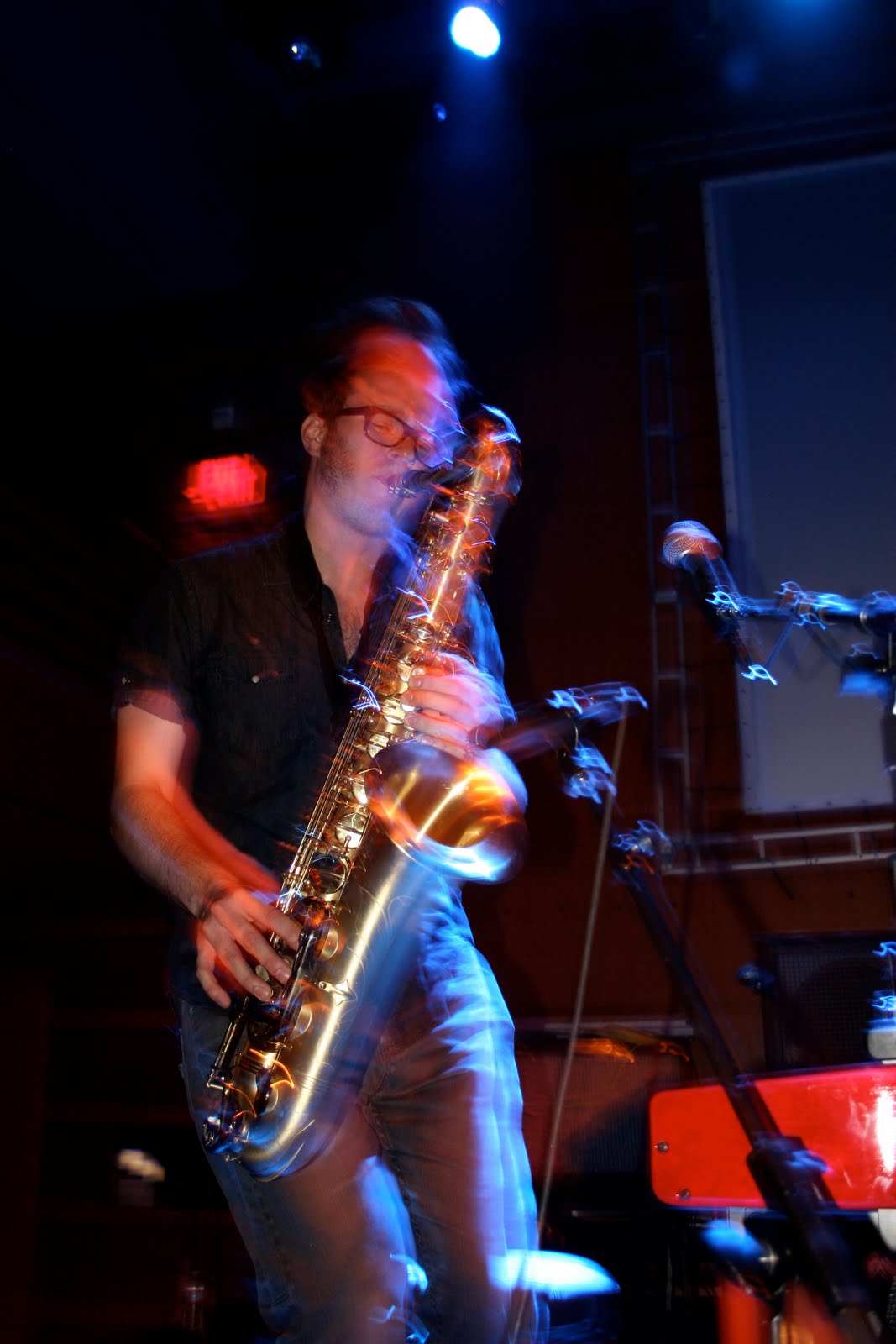
By 10:00, Menomena had hooked in their many instruments, and the four members finally took their place on stage. Bass, guitar, vocalist, and baritone sax player, Justin Harris joked with the crowd, apologizing for not having a 3-D show of their own. Despite the evident passion of the members, the interesting combination of layered sounds, and the amazing drummer who also picked up lead vocals from time to time, Menomena was still not quite captivating enough to overthrow the adrenaline Kiev produced early on. As Menomena finished up a little before 12:00, the final third of the crowd snapped their final pictures, stole set lists from the stage, and dumped their 3-D glasses off before they walked out the door.

Set List:

Ghostship

Taos

Five Little Rooms

Muscle N’ Flow

Tithe

E Is Stable

Queen Black Acid

Strongest Man in the World

Weird

Twenty Cell Revolt

Bote

Libido

Dirty Cartoons

Friday, May 20, 2011

Kiev Goes 3-D with Menomena at Samueli Theater


What: Menomena w/ Kiev

Where: Segerstrom Center for the Arts, inside the Samueli Theater

When: 8pm, May 24, 2011

Tickets: $20 and $40

Purchase Site: http://scfta.org/home/Events/EventDetail.aspx?EventID=1213&NavID=355

A few days ago, I was able to congregate with the members of Kiev, including Robert Brinkerhoff (vocals, guitar), Brandon Corn (drums), Derek Poulsen (bass), Alex Wright (keys), and Andy Stavas (keys, saxophone), to discuss how much things have progressed since their last OC Weekly interview a few years ago. Not only did we converse about how the five members formed Kiev up to this point in time, but also their musical plans for the future, their take on the Orange County music community, and how the support of the OC Music Awards helped them connect with Menonmena for their upcoming show at the Segerstrom Center for the Arts, inside the Samueli Theater this May 24th. On top of that their performance will involve new technology that produces 3-D images projected on stage, set to synchronize perfectly with the layered tones of their music as they play!

So how did you end up together in this final formation of members?

Robert Brinkerhoff: We all met in stages, a staggered introduction. We only met through music. None of us were childhood friends who got picked on and started a hardcore punk band because of it—none of that awesome classic kind of stuff. Brandon moved down from Washington for a change of pace. We heard rumors of a fresh new kid on the streets who plays the skins. We met through mutual friends, and eventually he came down. We had already auditioned a bunch of drummers, but Brandon was really good, and he was pretty weird. The band was just a name previous to meeting Brandon. But I think upon meeting Brandon, that was the first seed, the first connection of the creation of what Kiev is now. So we kept him around.

I think we played around for about a year before we met Derek, and we met Derek through mutual friends as well. The first time I remember meeting him in the flesh, he was running sound at Cal State Fullerton. We knew of each other, and I remember hearing more rumors, like, ‘Hey, my friend is dating this dude, and he’s really good at music.’ That’s when we started to experience a metamorphosis. I think it was in year increments, maybe a little less.

And then Andy, the sax and keyboard guy, moved here. Through the guy we rent our warehouse from, we heard, ‘Hey, I know this kid that moved out here, and he plays for a Gospel church in South Central.’ We thought that was way cool, ‘cause we had coincidentally been talking about wanting someone to play keys, and hoping they would have other skills-- like being able to play a brass instrument. When we met him, he was just this goofy kid fresh out of North Carolina, even though he’s originally from Nebraska. He was the total opposite from what you would imagine. He’s this healthy, blonde-haired, Viking looking guy who I kind of imagined being like a Phish fan or something. Imagining someone who plays in a Compton Gospel church, I pictured someone that was kind of groovy and cool. And then he was just this excited cheesy guy that was like, ‘Hi! I’m Andy!’ But the first time we played with him, Andy immediately accentuated this other side of us that had always been there; which was this side that was a bit more experimental, and had roots in Jazz. I think the very first time we played, he had walked in, he’d used the restroom while we were playing, and he immediately ran out, picked up a sax, and started jamming with us. We played for like an hour without stopping, thinking, ‘Man, that’s just so awesome.’ And he stuck around too.

About a year later, we heard more rumors—this is all about rumors— we heard rumors about this child prodigy pianist moving out. That’s what they said, that’s exactly what Andy said. Alex actually came here to the studio one time before he moved out, and he walked in and said, ‘This place is awesome.’ He laughs about the rumors, but he plays this song he wrote about his soccer team when he was nine years old, it sounds like Franz Liszt or something (laughs). At that point, our friend Grace who played keys decided she wanted to move to Oregon and study holistic medicine. She was a huge part of the band, but coincidentally, Alex was there, moving to California, telling us he was kind of good at piano. So we started playing with him, and he then accentuated this other side out of the band, which was this meticulous side, with attention to detail—he was a very disciplined dude. We rocked the boat on one hand with wacky Andy getting into jazz and free-jam, and then Alex came and re-centered the band with what he could bring to the table. It was actually really cool because I think for the first time, we felt like everything kind of fell into place. That wasn’t even that long ago, maybe over a year and a half ago. So it took a year for each band member to be found, and during all those years, we were pretty much only rehearsing. Incubating, for lack of a better word, in the warehouse. By the time Alex joined, we had a bunch of songs, but we’re still learning a lot about ourselves. We kind of figured out was what our strengths and ambitions were when he came. So we’ve continue chasing after that.

Now that you guys have your collection of songs, what have you been incubating to release next?

Brinkeroff: I think the most pertinent thing is the show at Samueli. It’s a pretty huge step for us. We’re going to be playing some brand new songs that we haven’t played, so that’s where our heads are at, because we still realize we are writing an album. But more immediately, we’re going to be sharing new music, and for the first time with visuals. As crazy as it is, we’re doing it in 3-D, mainly because people in my family, some filmmakers, and some animators we’re working with from our circle of friends have been playing around with 3-D stuff in their own work. They’re like, ‘Well, we have this gear, and I know you guys want to do projections. Why don’t we just take it a step further, get ridiculous with it, and make a 3-D show.’ As funny as that sounds, it’s actually something that’s been on our minds—not necessarily 3-D, but adding that next step with visuals. We actually had a personal goal, by this late Spring, we wanted to do a show in a warehouse, with visuals, and invite people into our workspace. We didn’t really think there was a venue that could we do it at. We can’t set up at Detroit Bar, can’t just book a show at House of Blues and have the control to oversee that and have a proper sound-check.

How did you get connected with Menomena, and the people at Samueli Theater for this event?

Brinkerhoff: It was actually Ashley from the Orange County Music Awards, and the ACE Agency Group. They hit us up to open the show for Menomena. They’ll be doing a series of shows. I’ve never seen the theater, but Derek, Brandon, and I, coincidentally, have done some music work in collaboration with visuals for the Segerstrom Center for the Arts. We were lucky to be able to work on an event in the past there. We were part of a group of musicians who supplied music to this experimental alias torque dance thing. So we had a relationship with the theater, and then we were coincidentally asked to open the show. They offered a sound-check, and we were panting like dogs, ‘cause we never get sound-checks, and sound is so important to us. And then they were like, ‘Yeah, and it’s at Segerstrom Center, in the Samueli Theater.’ So instead of doing visuals in our warehouse, we decided, let’s see if the theater would be cool with it, since they already know who we are. We asked them, and they thought it would be really cool.

How do you feel about a bigger show like this coming into our realm, and in an art theater, rather than a venue?

Brandon Corn: It’s a nicer place to experience music, as opposed to just seeing it in the same hole that we’re all used to. We all know how it sounds, we all know it’s going to be predictable.

Brinkerhoff: Not only will the theater sound nicer, but it will be a cooler environment. They are catering to another level of engagement. It’s nice being able to do something different than we’re used to. We’ve played in Orange County kind of recently at House of Blues, and before that, at the Orange County Music Awards series, but we really haven’t been playing around here that much. It’s just really refreshing thinking about, at least for us anyway, treating it with the high standard we’d like to hold ourselves to. Yeah, it’s a $20 show, but we’re putting in the effort to do something really special. Not just to make up for the dollar that comes out of the fan’s pockets, but just to incite the idea that, if you want to bring better and cooler shows to Orange County, then I think local bands, at least some of us, would love to step up and contribute back to that—so it’s not just us doing the same thing, playing the same bars. I think a lot of bands, including ours, have bigger aspirations. Might as well start doing stuff at home first.

The opportunity is there when Ashley Eckenweiler and Luke Allen provide new chances for local musicians to succeed, with things like the OC Music Awards.

Brinkerhoff: When I was just starting out, I was Luke’s first tenant in his studio rental space, Gemini Studios. He’s awesome, because he’s always been supporting it one way or another. And now it has been much more hands on with him and Ashley. It’s a way larger scale. Going to the Awards, as you’re taking it in, you realize, there’s no real reason for them to do this, other than that they’re supporting it, and they actually believe in the value of music and a music community. I guess we were all hoping that all the bands felt that way, ‘cause you can get really cheeky with it. I think of it as exposure, the chance to put everyone in the same room and introduce people to other people, as well as giving recognition to people that try really hard.

Corn: I think that’s the end goal behind it, is to honor specific people, but give exposure to everyone that participates. That sense of community is the most important thing that they have brought to the table.

Brinkerhoff: You make those connections with people you’ve been living next to the whole time. The music community hasn’t always been as vibrant and receptive to being more of a communal thing until lately.

Corn: It’s nice to know who your peers are. And also it will inspire friendly…I don’t want to say the word…competition, but in a positive way. Not head-to-head, but more of an inspiration. Another example for us is Railroad to Alaska. We had met them through that, playing the Best Live Band show.

Brinkerhoff: That show is designed, in a nice way, to be a competition. It was an introduction to a band that’s doing something totally different than us, but seems to be really like-minded in their integrity. It makes you feel better. There are not too many things to be comforted by when you’re a musician these days, so when you meet other people that are driven by the same things, and are as genuine and passionate about music, it makes you feel like, ‘Oh wait, maybe Orange County is not such a bad spot.’ There’s definitely a stigma with this area, about it having cliques, and being a little bit more competitive. When you actually get to meet, you realize that a lot of the people that we connect with are kind of longing for the same thing. They would rather have a community and support system. We have so much music here that we can actually have an awards show, so that says something.

That stigma is definitely around, and people have that frustration with Orange County, but Costa Mesa has a scene, Orange has a scene, Santa Ana has a scene. With that being said, why did you choose your home base to be in the City of Orange?

Brinkerhoff: You’re sitting inside of it right now. Wherever this building goes, we’ll go. If this thing picks up and lands in Albequerque, we’d be there. It was funny, I actually came here to go to film school at Chapman, and became really involved with the music, and that’s why I started living here. A while back our current manager was managing other bands, and renting out this rehearsal space. One of his bands he severed ties with, they moved out, and we were looking for a place to practice. Then we came here (to the studio), and thought it was pretty magical. The longer we’ve been here, the more that we’ve carved it out as our own home.

Corn: When it started, it was just us in that corner over there…

Brinkerhoff: …with a couple amps smashed in the corner. Then slowly, over the course of the years, we made it our home.

Corn: It’s a reflection of our growth too.

Brinkerhoff: I know I was raised here in Orange County, but I feel that we’re all a little nomadic in nature-- which is super ironic since we’ve never moved. I know we all have the urge to want to feel free and move around, but as long as this warehouse is here, I have a feeling we will be here. Hopefully we’ll feed our nomadic tendencies by touring elsewhere.

After playing a large show with Avi Buffalo at the Art Theatre of Long Beach, and with this upcoming collaboration with Menomena, do you feel the need to continue the trend with a tour, or will you choose to wait?

Corn: It’s hard, because you can book a tour on your own, but you’re almost guaranteed to lose money on the first couple dates. I think touring is definitely on the horizon, that’s for sure. But I think it’s also important to make sure that it’s done well and done right. When we were kids and we were going out and touring, to me it felt like a totally different thing because gas was so cheap…

Brinkerhoff: …and no Myspace, Facebook, Souncloud, or Bandcamp.

Corn: And we still had the huge map and the book of CD’s in the car. It costs a lot more nowadays to fill up the tank and things like that. So logistically, it’s more difficult to tour these days I think. With that being said, we want to, very much so.

How do you get connected with record companies when they seem to be in as much trouble as everyone else?

Brinkerhoff: You gotta get connected with the bands, and that’s why we’re grateful to get some of these bigger shows. Just to be able to brush shoulders with some bands that are touring acts. We spend a lot of time with Orange County and Los Angeles bands, but not really bands from out of town. We seem to be a little less focused on touring with what we have right now. Like all bands, we are going to be continuously developing the music. I think we’re really eager because we do have a new batch of songs, and we want to round out that batch and make it a true album. I’m not saying that we won’t tour. We’ll take any opportunity to travel if we can play for people, even if it’s just a few. But I think the priority would be to complete an album. It’s been lucky that we developed a relationship with an engineer that we really respect, and he works on all these records, some of them being some of my favorite from over the last 20 years. We just recorded with him last week, just to see what it was like. It seemed like a really cool fit, and there is a lot of potential there. It feels like the natural progression for us, since the band’s progression is a little bit ahead of the available recorded music. For us to put our newest stuff out as quickly as we can, intelligently, and as cool as we can onto some recorded medium so it matches what the band is doing will be best. I think at that point, that’s when you feel most ready to take a risk on a tour. It’s like, ‘Here, we’re most proud of this music,’ and it’s the music people haven’t heard yet. I know that’s always the case with bands, but I think it’s particularly true with us right now.

When did you record last, before this most recent session?

Brinkerhoff: Two years ago, almost. I think that it was such a gigantic task for us to graduate from where we were previous to those recordings. We grew to the point of where, we recorded those songs, and even more, we figured out how to play the music live. We try to incorporate a lot of technology. Apart from the technology, just the idea of playing such multi-layered music, and building it from nothing--in the hands of five people--has taken us a really long time. And we continue to learn a lot about what it is we like and what we don’t like about what we’ve already made. Two years sounds like an incredibly long time to have a gap, but people come up to us and ask how we make such layered music. It feels overwhelming when we make it, like, what did we get into? We had four days in the studio last week to record two songs. Most bands would be like, ‘Oh, we can record two songs in a half a day.’ Even the producer and engineer thought it would be fine. But as soon as we got going, he heard us play it live, and he was ready to jump on it. As soon as we started breaking down all the layers and told him what we wanted to do, he was like, ‘Shit, there’s so much to do.’ Fortunately he remained positive. A lot of people don’t realize that it’s really dense music, we really care about it, and we’ve spent a lot of time with it. Writing a six-minute song, for us, can sometimes feel like you’ve written a miniature symphony. You feel like a stressed out composer, thinking of all the different parts and counterparts and layers.

Being that you guys are so calculated in your composing, how does that tie in with the philosophy of your music?

Derek Poulsen: I think Brandon’s nature of knowing rhythms inside and out, and being able to break down rhythms to certain durations and subdivisions is pretty much the foundation of a tune. His abilities with drums and percussions are always a good place for starting.

Corn: That’s what gets us all moving too, the rhythm of it. It doesn’t necessarily start with me, but it definitely starts with a beat. Out of the batch of tunes that we’ve made, there were only a few that didn’t start with some sort of rhythm. For us, the placement of the rhythm, and the repetition of it in the writing process is part of it as well.

Brinkerhoff: I think we are very meticulous and disciplined people, but on the opposite side of the spectrum, we spend a lot of time as individuals and as a group, trying to be as meticulous, disciplined, and trained. We practice almost in preparation for these really organic moments when divine intervention comes through, so that we know how to interpret it quickly as it happens.

So you cover all the little details, practice all the rudiments, you know your scales and such, so that when the eventual moment of musical creation occurs, you’re all on the same page and ready?

Brinkerhoff: It’s just when the breeze comes through town. The thing I’m most grateful for about playing with these guys--‘cause currently I’m the only one who is not a trained musician-- is that when you have inspiration striking you, you have this tiny little pinhole to try and force out gallons of energy. You explode, and that’s when you turn into a prematurely grey, freaked out, shaky person. When the discipline is there more, the moment is able to be translated quickly. So when we have improv jams, it actually isn’t just us throwing paint at the walls for an abstract feel. It actually comes from an earned, educated place. It doesn’t make it any less improvised or genuine, it just that you learn you can speak without words. ‘Cause that’s exactly what music is, is a translation of all these thoughts, emotions, and feelings that don’t necessarily translate into words.

Explain a little more about what you have in mind for the 3-D visuals for the concert at Samueli Theater, and will the audience need 3-D glasses?

Brinkerhoff: Yeah they will need to wear the glasses, and the band will bring them. We have 400 pairs. We are going to bring in a huge screen, and it takes two projectors to do the kind of 3-D we’re planning. It’s not like we made a 3-D film and the music is a score to it. It’s basically visualized music, that is custom created media arranged in 3-D space to each one of our songs. Since we have computers incorporated into the band, we’re actually able to drive the projectors, keeping it in line with what images we want at certain points of the song. There’s been confusion about the idea like, ‘Oh you made a 3-D film,’ but we didn’t take 3-D camera, which consists of two lenses, and go film things. Instead, we have software and hardware connected to our musical software, that can remember and place 2-D images, or any sort of animation, in a 3-D space. So it’s multiple layers of things that can move and react to our music. We’re a little bummed on it though, ‘cause our backs are going to be to it during the show, and we won’t get to see it. We won’t be projecting it on ourselves, but we went through a bunch of different concepts before settling on anything. Secretly I fantasize about doing it at the Yost Theater, ‘cause I think there will be people who don’t know Menomena, or can’t afford a ticket, and I’d love for them to see it too. But it does take about 10 people to run the show, so we can’t really speak for the other five people that have to work on it. But they’re really excited about it too. We flirted with the idea of 3-D because of all the multi-layers in our music —that was the greatest way to actually visualize multiple layers of images as they react to the many layers of the music.

And ultimately, the whole point is to get lost in the music?

Brinkerhoff: Right. And some people are more visual than others. A lot of people talk about things they kind of feel like they ‘see’ or imagine when they listen to, not only our music, but other forms of music as well. Hopefully we’re able to help those who can’t see it as clear—cinestesia I believe it’s called—that’s when you see the color of music.