Pages

Showing posts with label omaha. Show all posts

Wednesday, June 1, 2011

Railroad to Alaska, Omaha, & Mammoth Thunderpower at Detroit Bar

Railroad to Alaska at Detroit Bar Last Night

May 28th, 2011

Detroit Bar, Costa Mesa

w/ Omaha and Mammoth Thunderpower

Tonight at Detroit Bar, the crowd of metal-heads made sure to grab earplugs before arriving for the Railroad to Alaska EP release show, featuring the heavy-hitting Omaha and Mammoth Thunderpower. For those who forgot their protection, there were plugs on sale at the merch booth, along with Railroad’s new four-track EP, titled Salvation, and a few newly printed t-shirts.

Starting off the night was Mammoth Thunderpower, a Costa Mesa metal rock band just recently formed. For their second show of all time, Thunderpower offered the perfect orchestrations to build and wind the crowd up for beastly sounds of Omaha to come. Most notable was the double-peddle booming from the drummer, the Sabbath-like riffs from guitarist Jeremy Munoz, and the lead vocalist, spouting vocals inspired by Suicidal Tendencies and Adolescents.

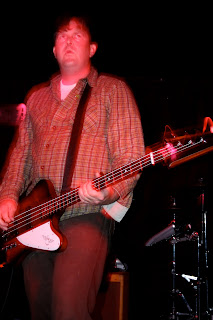
Although Omaha consists of only three musicians, each member brought enough power to overwhelm a band twice their size. Bassist and lead vocalist, Brandon Seger, cast a dark shadow over the thick crowd with his intensely furious lyrics, while each note from guitarist Ben Brown created a little more electric anxiety around onlookers. Behind his massive drum kit, Jon Maherhan, kept a perfect, yet uneasy beat that kept heads bobbing throughout their set.

As the dancefloor filled to the brim with loyal fans, the lights lowered to black, with the stage still empty, but pulsing with musical possibility. Wasting no time, Railroad opened with up-tempo track, “Handsome,” sending the front of the crowd into a frenzy. One by one, each song took on more life, with members Justin Suitor, Justin Morales, Jeff Lyman, and Derek Eglit, becoming more unhinged as they fell deeper into their set. Although most of the music was new tonight, Railroad sent the final shock across the crowd during their encore, featuring the hit, “White Nite.” By the final note, the crowd was sweaty, beaten, and looking for a copy of the EP and some fresh air.

Overheard: “Look at all those panties!”

Set:

Handsome

Make Mother

Indian Death Cheer

The Real Thing

Bible Pelt

White Marbles

Antique Roadshow

Mum

Coffin Drag

Learn to Share

Janie Had a Boyfriend

White Nite

Friday, May 27, 2011

Railroad to Alaska Releases "Salvation" EP

(L-R) Justin Morales, Justin Suitor, Jeff Lyman, Derek Eglit
Photo by Austin Bauman

Before their EP Release show at Detroit Bar this Saturday May 28th, Railroad to Alaska members Justin Suitor (vocals/guitar) and Justin Morales (bass) filled us in on what their newest release Salvation is all about, their plans for an upcoming full-length, and their ideas on touring.

So what is your game-plan for Saturday?

Justin Suitor: We haven’t headlined in a long time, so we’ll be playing a longer set. We’re going to try and play old songs-- not obscenely old, just off of the first EP-- and songs off of the EP we’re releasing now, and songs that may or may not be recorded on the full-length album we’ll be recording in the next couple months—some brand new stuff that people haven’t heard.

So for the first EP, LuckyBearClawDoom, you had one concept. Has it changed as you went into producing the second EP, and how would you describe your newest concept?

Suitor: Yeah, definitely. Well the first EP was out of necessity. We just needed a recording. I don’t think anybody in the band had any grand ideas about what the concept was. I think it was something that we put together, and then explained. On Salvation, we had a little bit more of a concept, but it was kind of born out of necessity too. We needed an updated recording. I guess when you’re in a band and you’re functioning on a level of not having a budget, you can’t really have a huge scope.

Justin Morales: I think that both records are just two incidental snapshots during a period of growth of the band, and they’re a year apart. Naturally, there’s changes that took place in there.

Suitor: The songwriting got more deliberate. When we recorded it, we were much more aware of the end product that we were going for. In terms of overall theme, we still didn’t really have any specific direction, whereas the full-length that we’re recording now--even though we are still in that “budget” category—we’re going to attempt to have an overarching theme and a specific direction, and we’re going to attempt to create an overall atmosphere and mood for the album.

So what would you say is the theme of Salvation, and what will be the theme for the full-length that will be coming out?

Suitor: Salvation has very few songs on it; it’s just an EP. There’s a song on there about drug use, a song about depression, there’s a song on there about being crazy, and there’s a song about weighing the ideas of hating yourself, versus being happy about what you’ve done on earth. So like Morales said, there are a few little snapshots within the EP that are little bits of everyday life. There was no theme on that, except for, we wanted it to be real, and it’s real. For the full-length, we can’t go into that because we’re still developing it all. It will be darker, and bigger, and a lot more serious. I think that’s what we gathered on this second EP—a lot more seriousness. We became more adult.

Why so serious?

Suitor: Because that’s who we are. I mean, even if we’re happy-go-lucky right now, we all want to play serious music, we’re all serious musicians. We’re trying to play hard, we’re trying to play tight, and we’re trying to play for real—we’re not trying to pull one over on anybody using parlor tricks. Overall, I think what can be said about what we’re trying to do differently for the show, is that we are trying to up our production level, to a place where we are holding the attention of the audience for as long as we can. It’s a lot easier in 30 minutes, but for one hour, we’re going to really have to dig deep and try to use lights, song order, and dynamics to our advantage—just really try to arrange all of that properly. I think we pretty much have that worked out.

How many of the songs for from the upcoming full length will be incorporated into the set?

Morales: It’s not really determined which ones are going to make the cut for the album or not, so we can’t really say for sure. We are going to play at least one that we’ve never played before, and three that most people haven’t heard before—and they definitely haven’t heard them the way we’re going to play them on Saturday. The newest songs are still in some stage of infancy, considering the transition that happens when you’re writing them—adding parts, taking parts away, changing lyrics, sometimes even changing key. It will be how it’s going to be on Saturday. Again, it will be another snapshot of the life of a song.

It sounds like you’re trying to progress in your musical work everyday then?

Suitor: Absolutely.

Morales: And learn from our mistakes, and learn from our triumphs.

When are you planning on a tour, and the chance to progress outside of Orange County?

Suitor: We don’t want to go on tour with EP’s. It seems a little counter-productive to leave such a small stamp in the areas we might tour. I think once the full-length is complete, we’ll try and pool our resources, determine the best possible way to tour without killing ourselves. We’re getting old and we’re not 21 years old anymore We can’t just leave for a year and roll the dice, so we need to make a pretty calculated effort on our tour. Admittedly, I know it demystifies rock and roll a bit. Right now we’ve got some dates in California on the Van’s Warped Tour. Once we see how that works, I think it will give us some incite on how to approach a tour where we’ll just be rushed in, rushed out, not really being that important—those things that go into playing on a side-stage show. I’d say by the time 2012 comes around, and if the earth hasn’t really ended, we’ll probably be touring the greater United States—in a Dodge Caravan.

Morales: Hopefully on someone else’s dime. That would be just magical if we didn’t have to find it ourselves. It’s not like we’re depending on it, or waiting for it, but if it happens, it happens.

How will you be releasing the EP? Will there be vinyl, digital download, a CD?

Suitor: We don’t have any ‘synergy,’ as Jack Donaghy would call it. We’re just releasing a good old-fashioned CD. I think that we will move towards a download, and it will be up on iTunes and all those other avenues. At this point, we gotta get people to pay. There are others who maybe can afford to give their music away, but we work hard on ours and we’re not asking for much. Give us like three bucks or something. It’s not for a 40oz. and a crack-rock. It’s for more gear, touring, and I think people will understand that.

When you do record your full-length, what type of medium are you planning on implementing?

Suitor: We’ve thought about tape, we’ve thought about various producers, we’ve thought about going back to work with our good friend Mike Troolines, but it’s undertermined. The material is taking shape, and that’s gonna dictate where we’re gonna go. If the material is more low-fi, maybe we’ll go for tape. If it’s turning into more of a production, and it’s getting more detailed and intricate, we’ll be forced to go digital. We tried something new with the mastering on this EP, with a new process that’s very futuristic. Maybe we’ll try futuristic mastering with lo-fi tape, lo-fi tape mastering after recording digital—we’re open to all that, but like I said, the material is going to dictate how we record.

Morales: It depends on what studio we record at, and what kind of gear they have. I like recording on tape, I’ve done it before. Having four guys on a huge Triton board all mixing down to ½ inch tape is crazy. One little mess-up, and it’s like, ‘Whoops, we gotta start over again.’ I really felt like, ‘Why aren’t we doing this digitally?’ In the end, it was worth it.

What can you say about the bands you are playing with on Saturday?

Suitor: We’re playing with Omaha and Mammoth Thunderpower. I don’t think anyone knows about Mammoth Thunderpower, it’s maybe their second show, and I know there are members from previous bands that we’ve played with, so we’re looking forward to that. We’re just happy to hear bands playing some hard rock. If they turn it up, and they play hard, we’ll be happy. And Omaha, they’re our good friends and we back them. They play sludgy, heavy, and dark music, and are serious musicians as well, and serious dudes too. That’s always a good pairing for us to play together because we were all to the point when we’re focused on playing. I’m not saying we’re not up there having fun, we’re not machines up there. But when we’re playing with those guys, they are focused, we are focused, and I think it brings a good vibe. People are there to see a show, rather than just to hang out. I think it’s a good lineup and I think people are really gonna enjoy. We’re also gonna have a guest cameo, Mr. Josh. People who don’t know who Mr. Josh is, they should come out ‘cause he has a carnival wheel that you spin and win prizes. Prizes vary all the way from buttons he’s made, to life-size cartoon paintings he’s made. He’ll also be handing out some of the band’s shirts and cd’s as well for free.

Morales: He may or may not be wearing a white tuxedo.

Saturday, April 9, 2011

Songwriters: Omaha

How long have you guys been playing music?

Jon Mauerhan: Since I was 12, so 23 years, with little breaks in between.

Brandon Seger: I’ve played since I was 15. Started on bass, and in my first band played bass. Played keyboards and guitar in other bands.

Ben Brown: I’ve been playing maybe 14 or 15 years.

And you guys played in other bands before I take it?

Brown: We all played in bands together at some point or another.

Maybe not all three together, but…

Mauerhan: Yeah, in different reincarnations.

So why is three the magic number for you guys when it comes to band members?

Mauerhan: I don’t think there’s any reason for it, we just knew it. We didn’t really explore adding a fourth member. I think the fact is that we’re tight-knit friends and have been for so long.

Seger: It’s easier, there’s less people.

Brown: It’s either option one, two, or three.

Seger: And there’s good two-on-ones, when you hit a stopping point. With a four-piece, you can get a two-on-two situation going, which could put a stalemate on the process. But with a three-piece, you have that dynamic of two people outweighing the one, so decisions get made quicker which is good. And then the communication of our group is pretty high.

When I watch you guys, there is a definite beat going, but you each seem to be in your own world, within that beat. Is that what you’re focusing on when you’re writing? And what instrument is starting the writing process most of the time?

Mauerhan: Yeah, and I think if you add a fourth layer, you might lose an element of that.

Seger: A lot of times, Ben comes in with a riff. We develop it and shape it as far as how long sections go. With a three piece dynamic, you have interesting options, where, if one member drops out, that just leaves two people playing, and it’s fun to mix that up a little bit. That’s another way how the trio actually does creates these options that bigger bands don’t have as much.

Brown: Yeah, and we’re kind of forced to push the limits in terms of dynamics because we only have three instruments to work with. Some bands with two guitarists, they can really develop that dynamic between the two, and add the layering.

And you are playing both. It’s nice that Brandon keeps that bassline, and lets you venture out into both realms.

Seger: Yeah, he gets to play rhythm and solo. You see a lot of taking turns in bands, but with ours, it’s always been his turn as guitarist (laughs).

When you’re putting a song together, you have these epic, intricate songs that you’re playing. You go into writing them with a certain riff usually and build off of that? Do you have an idea of what the structure is going to look like as a whole?

Mauerhan: I think it would be various levels of that. There’s times where we would come in with something, and Ben’s come in with a lot of ideas, verses, choruses, and other things. Other times, just a simple riff will blossom into something that we never expected. Songs always end up taking on a life of their own, off to places you never planned.

What do you think determines that? Vocals come later for you guys, right? So do you have a certain image or feeling you’re attempting to provoke?

Brown: We’re always considering where vocals are going to fit in to these pieces throughout the whole process. And then it’s just a matter of fine-tuning and layering the vocals in there, and then adjusting accordingly.

Mauerhan: I’d say there are almost always changes once the vocals come into play. The minute Brandon sinks his teeth into it, a lot of times he’ll come back and say, ‘I’ve got a great idea, but we’ve gotta change this to make it work.’

Seger: We learned a lot about that in the recording process. About how we create songs, how we work with the lyrics, and just being able to hear it, without playing it, over and over for that many times. It’s been very helpful for me.

With your playing bass and singing the melody, are you doing two different things rhythmically, or do you write with intention of synching it up to the bass?

Seger: It goes back and forth, but most of the time, the vocals don’t have a lot to do with the basslines, per se, but then there are other times when they do lock in together. That goes both ways. It’s always tricky to synch them up, but once you got it, you got it. So I enjoy that aspect of the band, and the fact that it’s constantly challenging me. I’ve improved a lot since starting to play with these guys again. Really kind of exciting process, and nerve-racking.

Seeing how far you can push it?

Seger: Yeah. I suppose seeing how far you can push it.

Do you guys all read music?

All three: No, not really.

So you just “hear it” when you’re writing and playing? Do you rely on mathematics at all when you write?

Mauerhan: Sometimes there will be mathematical concepts in there. If Ben is playing in 3/4, and I might have some rhythm that might have like a 5/4 feel, it’s fun to kind of switch it up and things like that.

Seger: We work in those off-beats quite a bit. It’s usually a little off-balance and precarious. I always feel like you’re almost on the edge, you’ve got that weird feeling like you wanna lean over it. A lot of the riffs and rhythms that we end up doing give me that sensation, like we’re just a little off-balance. You’ll see people kind of going with it in the crowd, they kind of lose it for a second, then they come back to it. That’s how I am when I first hear the riff.

Mauerhan: It’s kind of a struggle to make something that off-time, but still feel like you’re flowing in something continuous.

Let’s look into band philosophy, like what you stand for, and what you’re trying to express through your music. How does being on the edge depict what Omaha represents as an idea?

Seger: We set out to write dark, heavy music, and there’s any angry edge to it. I think the reason we gravitated towards it, partially, is that we’ve all listened to that type of music and gone to those types of shows together for a long time. But we’ve never done a band like this together. So when we were getting together, if we had a philosophy about the feel of the band, it was dark, angry, aggressive, and as heavy as we can make it. Then lyrically, it just channeled right into the way the lyrics come out, where they are often describing frustrating situations from a certain point of view; either the person who is creating the frustrating situation, or whether it’s from the point of view of the person who is being oppressed.

Mauerhan: Playing angry music is a good outlet. It limits how much you have to experience those emotions in normal life. Sometimes I’ll come here from work, feeling all tense, and afterwards, I can feel the blood flowing through and I’m relaxed.

So do you think that is something people need to tap into on a regular basis? They need a way to get that emotion out?

Mauerhan: It doesn’t necessarily have to be music.

Seger: A healthy way to vent is definitely a good thing.

Mauerhan: I listen to heavy music less and less as the years go by, but as a drummer, it’s really the only music I want to play.

Well it’s always more fun when you’re having a good time and it’s a shared experience. It’s hard when band’s put specific restraints and expectations on themselves.

Seger: I’ve been in bands that felt like work for me over the years. This is just fun. Practice is fun. Recording is fun. Playing live is great.

Mauerhan: You asked about the point of Omaha, I think that’s a big one. The biggest reason we first started is because it’s fun to do this and have the camaraderie.

Monday, March 28, 2011

Introduction to Songwriters Collection

What does it take to write a song? Why do some people string together chord progressions so effortlessly, while others slave over every piece? Is it important to tell a story, or does the inclusion of lyrics occur only so a melody to hum with exists? Do the technical musicians quell the simpler songwriters, or can a simple three-chord change inspire more overall emotion from the listener? And in the end, is it the audience member that gives the song life?

For some, songwriting is an organic process that grows in the seeds of personal practice, while others find their stride within the jam circle. Records are made in so many ways these days, whether it involves capturing rough cuts on tape recorders, tunes made in warehouses and garages on personal digital devices, or albums produced by a professional studio that house ProTools, plenty of equipment, high-powered computers, and the finest acoustics. As I carefully studied each perspective, I began to realize there was no cut and dry manner of making a song. Most musicians that spoke of his or her inspirations, stuck to specific songwriting practices of their own. Others revealed that they enjoyed reinventing themselves by morphing in phases with the style of their music, just as an individual morphs during his or her lifetime.

In the end, the hunt for the key to songwriting became clear: it is about self-expression, and discovering a Harmonia with yourself and your bandmates. To be culturally aware is to be an artist, and the truly great songwriters speak and play from their heart in reference to the world around them. They create with the intention of portraying the emotions felt by humanity, but that most individuals are unable to express because they are not practiced in the process of artistic interpretation. That being the case, it is never too late to start thinking about the music we choose to listen to, and why it is relevant in our day-to-day life. Then, as an audience member and fan, it is always possible to be part of the journey of songwriting.


Keep and eye out for interviews from:

The Growlers

Billy Kernkamp

Stanley Lucas Revolution

Honeypie

Echo Echo

Tyler Ellis

Omaha

Railroad to Alaska

Snakebit Drifters

Drums and Color