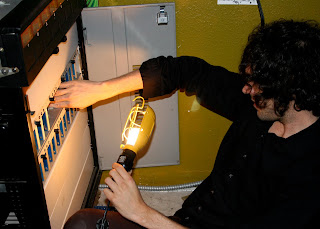
After almost a decade, Rip "Ripper" Morgan of Third Garden Studios in Costa Mesa has advanced out of his basement studio in Newport Beach, and into a cleanly built studio off of Placentia Ave., that he actually fashioned with his own two hands. This contractor and landscaper focused on his work for over 20 years, leaving the world of music for quite awhile to make ends meet. Now, 30 years since he connected with the music scene, Morgan has found his way back and is participating more than ever. He took the time let me see the studio, and to enlighten me with his passionate ideas, many of which inspired his Third Garden.
How many years have you been here at the Third Garden Studios?
Rip Morgan: Over two and a half years now. Three more months and I’ll be celebrating my third anniversary, and I still have never had an open house. I don’t know a whole lot of the young bands, ‘cause I haven’t really been going to those indie-style shows, but I started getting into it because of Cassie (Walter). My band, we just play like classic covers and the stuff that we write, which is a lot different. It’s independent, because it’s us, but it’s not what all the young kids listen to who are coming out at 11pm at night, enjoying rock n’ roll of a different style.
When did you first start getting involved with music?
Morgan: Well, we are about nine years into the Third Garden project. Started, of course, in a bedroom, moved to the living room…
Then to the garage?
Morgan: The garage was like 40 years ago, the garage was cool then. But if you want to really cut lose, you gotta have a little more than a garage—unless you’ve got the money to spend. I started by thinking, ‘I’d really love to have a place for my band and I to rehearse in, and have it be a place we could always go and not bother anybody.’ So we found it, and that was down in Newport Beach. Very nice little place, and it worked out really good for a while. When we moved in there, it rained for like three weeks straight, and I had a river running through the studio. It was a basement that was all dilapidated, and water flowed right through it. I started the remodel, staying away from the river. I actually cut a hole in the wall and made a little trench in the concrete so that it would drain out when it got really bad. It was a daily deal for a while. Eventually, I got it all fixed up, and that was the beginning of the Third Garden. Two and a half years ago, I moved. The landlord and I had a good idea, but it fell through, so I had to move. I’m kind of glad, ‘cause in the beginning it was kind of hard, thinking, ‘Oh, my beautiful little place!’ You put your heart and soul, time, and muscle into something, and then you have to go. But it transitioned well. When I first started, I never really thought I would want to do recordings, or have a rehearsal room, or really get into the music scene.
You were just looking for a place to play?
Morgan: I just wanted a place to play. In the ‘70s I had the Boiling Mud band, and several other bands around Orange County—playing just rock n’ roll and popular covers. That developed into another family. I had two families; one before rock n’ roll, and one after. So I had a big 20-year period where I wasn’t doing much music, I was just working hard and raising a family. Things worked out to where my wife and I separated, and I went, ‘Wow, I just gotta get back into music.’
So you hadn’t been doing music all that time?
Morgan: Well, not really. I was a contractor and that’s all I did. I did have the acoustic guitar, and I’d strum it once and a while, but it wasn’t what I had to do at the time, and I had no equipment, nothing. But when things changed, and Ralph, my son, grew up, and we drifted apart from mom, I said, ‘Let’s get back into music.’ So we started in the living room. I never really thought, ‘I’m going to be recording big hits, produce people, promote people, play music myself, and still try to write stuff.’ I decided, I’m gonna play music, have friends come over, and have little jam parties. People then started saying, ‘Our band would sure love to rent this place,’ and it started into a whole deal. So I went, ok, that’s it. We’ll rent the studio out for free little rehearsals, and then I’ll learn how to do the engineering, get some equipment, try to keep it on a good budget, and open up a full recording studio. We started with just the little Yamaha 8-track, and then wanting to step up a little bit, I learned how to use ProTools.
It has definitely been a huge help to many musicians, having ProTools.
Morgan: It’s not like in the ‘60s and ‘70s when I first tried to get into recording. The development from that stage to now is a millions times better, much simpler.
You can write more information, store more, and change certain parts easier.
Morgan: And you can get it all done in a little room like this. Even like Babeland, in the bedroom.
When did you start getting out of your circle of friends? Did that come when you started working with KOCI?
Morgan: The radio station helped a little bit. About two years ago, just after I moved in here, a friend of mine, Michael Ficklin, who was my drummer occasionally who lives in Laguna, invited me over to be with him on an interview on KOCI radio. I’d never heard of it before because they had just come up. It was probably six months or so before they really were a radio station, on the air, and doing stuff like a radio station. So I went over, you know, to check it out. They were working on the first concert ever, and it was one week before the event down at the American Legion. There were four good Blues bands scheduled to play, and it was kind of a big deal ‘cause they had to get 300 people in the American Legion. So we do this interview, and I actually brought three songs with me that I had produced at the old studio and they played one for me on air. I didn’t expect them to do that, but I thought, ‘I better have something in case they ask.’
I was walking around meeting people, saying hi, and then Michael Donahoe comes out of another office over there. He was over there discussing work with KOCI, and that was the first time I met Michael, who I work with and is now my partner. When I met Brian Helvey, the director over there, we’re just sitting there talking and Brian is all nervous saying, ‘We’ve got this show coming up, but there’s nobody to do the sound.’ So it was like, here comes Rip of Third Garden, and I’m standing there going, ‘You guys need a system and engineering. Ok, I’ll do that.’ It was just a given. So I had a week to prepare, but it was easy because it was a lot smaller than what we do now. Now we do the full sound-system. KOCI has developed, and we’ve both grown together. It’s good, I’ve done a lot of stuff for them, and they have done a lot of stuff for me. I’ve met some great people, we’ve been meeting more and more bands to get them on the venues, and it’s been a great deal.
Now Semi-Sweet. It was actually Cassie that came to Third Garden with Dan Chapin about four years ago. I’d known Daniel from my son’s school, Christ Lutheran. But it didn’t register for a little bit, until I finally realized it was him, and that he was all grown up now and playing guitar. So they would rehearse at the old studio. Alysium, that was what they called their band. Cassie came and sang a few times with the band, and that’s when I first met her. She didn’t play guitar, she just came out to sing, and I still have one recording of it. Then Dan joined the Army and the band just kind of went away. Then the next thing I know I’m watching this band one day, thinking to myself, ‘I know that girl.’ It was the Semi Sweet band—the all-girl band, before the guys joined. I thought she was so cool, she had a guitar at that point, and she’s writing all these songs. I was impressed, so I contacted her on Myspace. She remembered me, and so I told her, ‘I’d love to record you guys, you sound cool.’ I told her I’d give her a good deal, come over and rehearse at my studio. She thought she was going to the old studio, but I told her no, it’s the new studio up on Placentia Ave. Derek (War) was there at this point, the girls, and another guy guitar player. That was before any of the EP’s. So I told them to come back any time they could. We did some recordings, they rehearsed a little bit, and then they were having problems with sound at the shows, so I told them I’d come out. Ever since then, I’ve helped them from time to time.
You mentioned you are partners with Mike Donahoe, how are you affiliated with him?
Morgan: He has a mobile telecasting van, and that’s partially Third Garden, partially Mini Big Productions. What Third Garden does, is provide this space here at the studio—the sound stage and the video stage, since we record video here too. We link them up with the remote van outside, and we can go anywhere in the city, and broadcast live. So, another part of that is Mini Big productions with Mike Donahoe.
You two work together on events, but you also wanted to get more local bands into the studio and do Friday-night shows?
Morgan: We’re already doing the Friday-night, which is the Local Musicians Jam Night. We don’t always broadcast that, but we have been, and we can if we want, or we can do any other night, and events outside of Third Garden. I was thinking of keeping it in the studio because it would be easier here and we could always assure a good sound. But we’ve been working on going out and Michael has done it several times. We setup at the Westside Bar once, and he’s done Westside two other times, and Pierce Street Annex as well.
So you could go in through the back of Detroit Bar and broadcast a show?
Morgan: Yes, outside viewers could be watching that show, that’s right.
Friday night is a continuous thing right now for you then?
Morgan: For Live at Third Garden, we’re trying to practice setting things up as fast as we can. Of course we know we can do it fast, but we’re working on the routine, know what we’re doing, and get it all done in a short amount of time.
Put every piece up, tear it all down, put it all up, tear it all down… That’s definitely a way to get quicker. Since the studio has been here, how long have you been doing the Friday night Local Musicians gathering?
Morgan: About six months. We started when KOCI asked us to play at Rockin’ For Radio IV. I thought, ‘Third Garden hadn’t played for about a year, so what are we gonna do. We’ll take Friday nights—usually my slowest night at Third Garden, ‘cause most groups are out there partying, doing their thing, or playing music. So we decided on Friday nights to get our band together, do the gig, and it developed from there. We thought, let’s keep doing it. We might be playing another Third Garden show this Summer, at Sawdust Festival and the Back Bay Environmental Center, with KOCI Radio.
How did the name and concept of Third Garden come about?
Morgan: I bit into the study of the Urantia Papers for quite a few years, and I was really heavily into it. I read the Bible, all of the Urantia Book, all the philosophy, wanting to seek something beyond mortal and beyond Earth. In the reading of that, lately, like within the last 20 years or so, I’ve really gotten into the concept of the Garden of Eden, which actually was on Earth. I don’t know where for sure, but I have an idea. And the first Garden of Eden had a default, and they were expelled from the First Garden. This was a necessity. Once they were out of the First Garden, they formed the Second Garden of Eden, which we now know is Iraq, basically. In Mesopotamia, between the Tygris and Euphrates Rivers; that’s what they call the Cradle of Civilization. And I kind of think that’s where the Second Garden was. That’s been quite a few years, maybe 35,000 or so. So a lot has been lost of the real history of our planet. Because of various things that have quarantined us and kept us out of contact with our celestial administration; namely Jesus Christ, and his Father, the one and only God. So getting back to the Third Garden, I thought well, I’m really kind of into that and I wanted to make a nursery for musicians. It would be like a garden where you grow plants. I had a nursery years ago where I grew stuff, and I called it the Third Garden, ‘cause I was a landscaper. I’d rescue a plant that would be torn out, then I’d take it out and transplant it. After about four years, I had a yard-sale and made about $2,000. I had hundreds of one-gallon, five-gallon, 15-gallon palm trees that I had kept and moved every time I moved. Then I started back into music, and it just came right into the studio. Well, it’s the Third Garden.
My first studio in Newport, I had the stairway going down, ‘cause it was built in the basement. So my Third Garden was going down the stairs and hanging up all over the walls and around the back. It was really nice. I had a lot of land to have the Third Garden nursery, and the Third Garden Studio on the other side. It developed into a great name, and then I name the band Third Garden. That’s how it evolved. So it’s stayed with me a little bit. The Third Garden nursery for musicians. There might be a fourth garden someday, who knows. But I had this crazy idea. Adam came to Earth for a purpose. And they did fulfill their purpose. They were admonished by that, but because they repented enough to be able to live as a celestial being. So maybe there’s a chance, if we created a Garden of Eden, someday they would come back and fulfill their purpose. I get into the spirituality a little bit. But I know that in all the universes of universes, Jesus Christ is the main person; our administrator, our sovereign, our life-giver, our love our savior, and that goes along with Third Garden—even though I don’t preach.
It’s all about being positive?
Morgan: It’s good, because it’s all about finding a purpose. We all have a purpose, and finding purpose is a hard thing. When you’ve got it down, you go, ‘I think I know what I want to do,’ and then all of a sudden it’s something else. Your attention goes here, goes there. I’ve been a contractor, builder, craftsman most of my life, and musician on the side, for 20 years. Then I decided to really get into it, and I’m hoping that it will evolve into something where I can make a living the rest of my life.
It’s difficult finding that balance.
Morgan: Well, you gotta have a little bit of money. You gotta be able to have your home, your studio, your livelihood, hopefully be able to pay all the bills, and do something you love. If you’re doing something you love, it’s more fulfilling. And music is fun, deep fun. I mean, you can have fun watching television, but deep fun is what really counts. Having that deep fun of being able to create something that is in your head, taking it from your thought, through your body and your fingertips, or your voice, and there you go—you created something. Something that will probably stay with us for eternity, hopefully.
So many younger people don’t understand what it is to make something. Meaning, deconstruct something in their head, and then produce it in a physical state. How do you feel about that?
Morgan: Imagination. Put your imagination to work, for good things. We all have big imaginations and if you can make your visions become a reality, that’s more deep fun. And that’s really the essence of finding your purpose in the mortal life here. We have many more lives to go through. I feel that each individual personality in the universe goes on for eternity. That’s forever, you say. So what are we going to be doing for all of eternity, what do we do? Well, we’re going to find out once we leave this planet, go to heaven, start learning what path to take, and what that path actually is. It could be, someday, an eon into your personal life, you might be helping another Jesus Christ construct a universe and planets. It’s limitless, because there is so much out there. It goes on forever. Maybe we might get bored. I kind of doubt it though, because you imagine waking up on the other side, it’s like, ‘Whooaaa.’
Perhaps city people don’t recognize that life is much bigger because it is too bright to see all the stars at night. I think that tends to make people feel small in comparison to the bigger picture.
Morgan: Daily lives, it takes a lot of energy, and you have all your priorities. But on the side, there should be something where you collect spiritual capital. You’re trying to make money to live, and maybe have some for retirement, so you need to do the same with your spirit. Learn it, think it, find out what feels best, practice it. You don’t have to go out and spew it all over and make people feel uncomfortable, because it’s all about you, the personal, and the individuality of each personal mortal, throughout all of the universe. I have no doubt that there are more mortals out there in the universe, and they’re not that far away, and they have the same purpose we do. I always get a kick out of sci-fi movies. They portray aliens as these incredible, gory, unbelievable monsters that the imagination can think up. But I think if we ever really do find out about how other planets are, it’s going to be basically the same type of life. We’re going to be inherently created in the image of God. Everybody’s the same—well not the same, because environments will create different types of species, but it will be inherently similar. Carbon-based units with water. If we find life, they could be similar to ours, and not these green, ugly, amoeba-type looking creatures that suck your blood. The imagination is a great thing to have. We all have a destiny, but it’s more important to find your purpose, and you can think, ‘Well mine is to have kids, or not have kids and help others, enlighten everyone with my music.’ A lot of kids, and even adults, get impatient. They want things too fast, and then never achieve them.
What’s your plan now? How many bands are you working with these days?
Morgan: There’s an average of five bands that are pretty regular, and there are a couple more here and there that are semi-regular. I’ve been getting a lot of people calling about recording, and people want to know how much, and what do we do? It’s tough to say how much, so I just go by the hour. So I’ll have people come in and record for three hours, and sometimes they can’t make it all the way through one take. That’s when I started telling people to come in and rehearse, I can listen, and when you play the song through, then we’ll record you. So a lot of people call and but then they lose interest, or they’re not together enough. You gotta think, well I’d love to do it, but I’ve gotta make money, how do I make money? And it could be from the production-side. I never made any money being a musician. But being a technician and a sound-man, I’m doing pretty good.